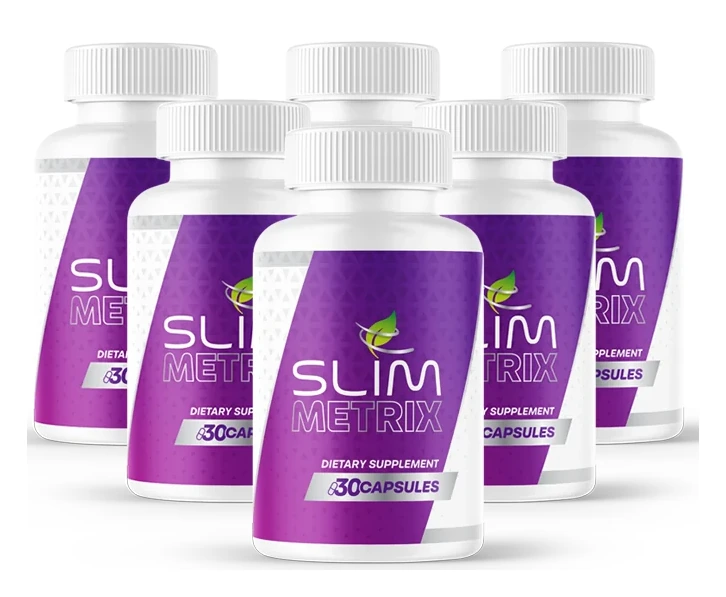
SlimMetrix Ingredients: SlimMetrix® Ingredients: #1 Doctor Reviewed 276 mg Blend Guide [2026]
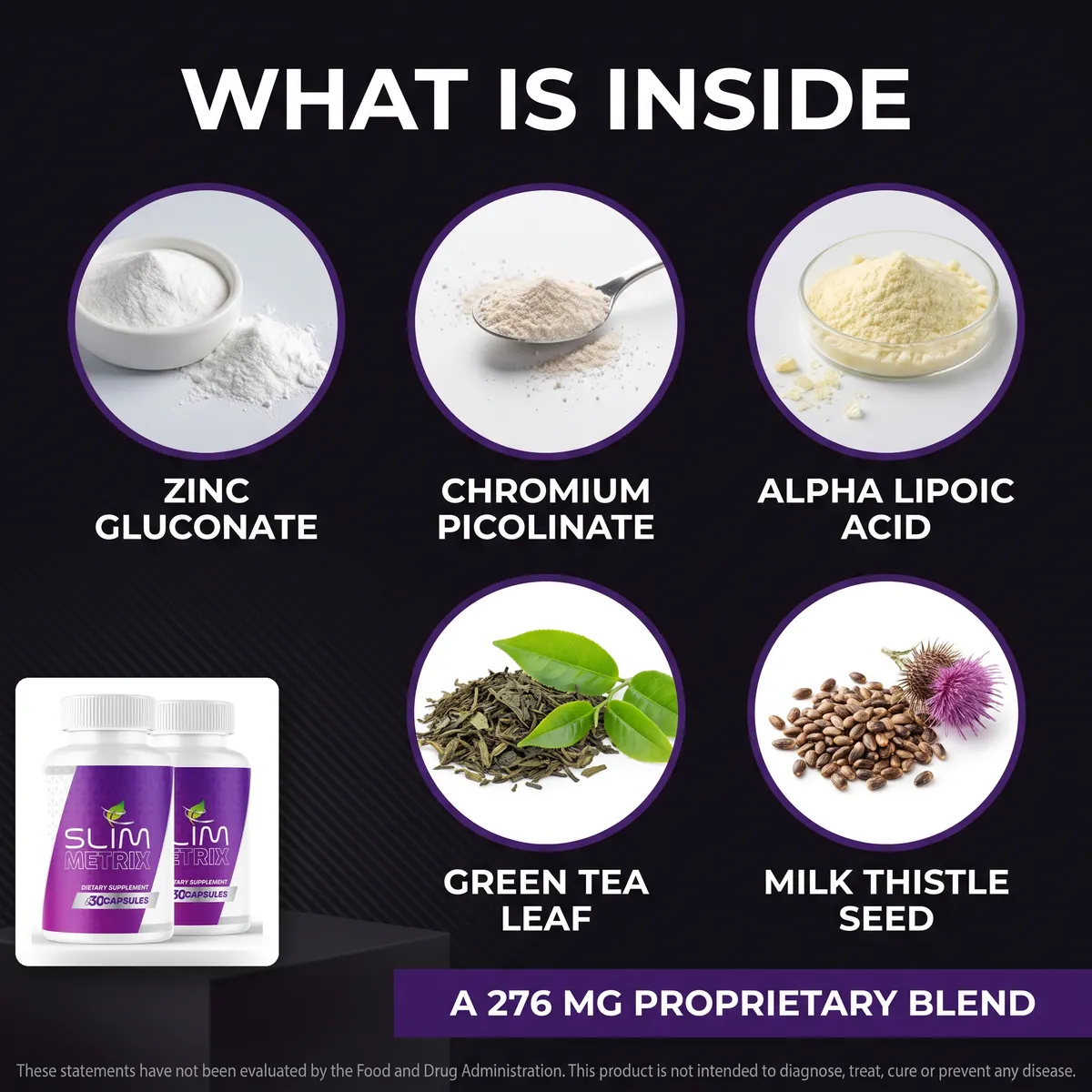
SlimMetrix ingredients number ten in the seller’s list: chromium picolinate at 50 mcg, zinc gluconate at 5.5 mg, green tea extract and berberine, plus six that share a 276 mg proprietary blend: resveratrol, milk thistle, cayenne, Korean ginseng, banaba and alpha lipoic acid. Only the two minerals carry printed amounts. The blend hides its split but publishes its ceiling, and that ceiling settles more than most buyers expect.
What a proprietary blend actually is
A proprietary blend prints the combined weight of a group of ingredients without publishing how that weight divides between them. It is legal in the United States, it is extremely common, and it exists so that a formulation cannot be copied ratio for ratio by a competitor.
What it hides is the split. What it cannot hide is the total, and readers consistently underestimate how much a total on its own rules out. A 276 mg blend cannot contain 1,000 mg of anything, because 1,000 is larger than 276. That sounds trivial written down and it settles more questions than any other single fact on a label of this kind.
The six ingredients sharing 276 mg
On this bottle the blend covers resveratrol, milk thistle standardised to 80% silymarin, cayenne, Korean ginseng at 8% ginsenosides, banaba at 2% corosolic acid, and alpha lipoic acid.
Four ingredients sit outside it and are disclosed differently: chromium at 50 mcg and zinc at 5.5 mg carry printed amounts, while green tea extract and berberine carry standardisation percentages with no weight attached. So this label discloses in three registers at once, which is unusual and is the reason it takes a whole page to read properly.
- Resveratrol — no weight, inside the blend.
- Milk thistle, 80% silymarin — a standardisation, inside the blend.
- Cayenne — no weight, inside the blend.
- Korean ginseng, 8% ginsenosides — a standardisation, inside the blend.
- Banaba, 2% corosolic acid — a standardisation, inside the blend.
- Alpha lipoic acid — no weight, inside the blend.
The arithmetic, done in public
Divide 276 by six and each ingredient gets 46 mg. That is the even-split case, and it is not a claim about this product: the seller has released no split and this desk is not inventing one. It is a reference point.
The useful move is to set 46 mg against the daily amount each ingredient’s own research used. Where an even split would still reach the studied dose, the blend is not the limiting factor. Where it lands an order of magnitude below, the blend is telling you something regardless of how the formulator intended it.
| Ingredient | An even split gives | What the research used |
|---|---|---|
| Resveratrol | 46 mg | Under 500 mg a day, per a 2019 dose-response meta-analysis in Obesity Reviews |
| Milk thistle, as silymarin | 46 mg of extract | 420 to 600 mg of silymarin daily, per a 2006 randomised trial in Phytotherapy Research |
| Cayenne, as capsaicin | 46 mg of cayenne | Capsaicin 2.56 mg with every meal, per a 2014 crossover trial in Appetite |
| Korean ginseng | 46 mg | 6 g of rootlets a day, per a 2013 trial of Korean red ginseng in overweight adults |
| Banaba | 46 mg at 2% corosolic acid | No single agreed human dose in the review literature |
| Alpha lipoic acid | 46 mg | Trials run to 1,200 mg a day, which reviews call the safe ceiling |
The left column is arithmetic on the published blend total, not a statement about this formula. The seller has released no split.
Read the Slim Metrix label with the arithmetic in hand
The ingredients page sets every printed figure and every blend member against the dose its own research used.
Two bottles $158 · six bottles $294 · 60-day money-back guarantee
Order Slim Metrix On The Official WebsiteOne capsule a morning · 30 per bottle · lot SLI-26/SL-3249
Which of the six could still reach its studied dose
Two, on an even split, and they are the two worth knowing about.
Cayenne is the clearest case. The appetite trial used 2.56 mg of capsaicin, and cayenne fruit powder carries capsaicin at a low percentage, so 46 mg of cayenne is in the right neighbourhood even though it would be delivered once a morning rather than with every meal as the trial did.
Resveratrol is the second. a 2019 dose-response meta-analysis in Obesity Reviews found its weight and BMI signal specifically in trials dosing under 500 mg a day, which means 46 mg is inside the studied range rather than outside it. Whether it is enough is a different question, and the dose-response work does not settle it.
Ginseng is the clearest miss. Six grams a day is more than twenty times the entire blend, so whatever the ginseng is doing here it is not reproducing that trial.
Why blends exist, and the defensible version
The honest argument for a proprietary blend is competitive. A formulation that publishes every ratio can be replicated exactly, and a company that has spent money arriving at a ratio has a real interest in not handing it over.
The defensible version of a blend has three properties: the ingredients inside it are all named, the total is printed, and the ingredients whose dose actually matters sit outside it with their own figures. This label meets the first two. On the third it is mixed, since chromium and zinc are outside with amounts, while green tea extract and berberine are outside without them.
The indefensible version is a blend whose members are not all named, or whose total is absent. Neither applies here, and a 2024 laboratory audit of weight-loss supplement labels is the reason that distinction is worth drawing rather than treating every blend as equally opaque.
- Every ingredient inside it is named.
- The total weight is printed.
- The ingredients whose dose decides the product sit outside it, with figures.
What to ask a seller about a blend
Three questions, in this order, and the answers tell you a great deal about who you are dealing with.
First: what is the split? A seller who will not say is within their rights and has told you something. A seller who says the blend is proportional to the research doses has made a checkable claim.
Second: which member carries the most weight? This is a softer version of the first and sellers sometimes answer it when they will not answer the other.
Third: is there an assay for any member? A certificate that reports silymarin or corosolic acid content would settle the whole question for that ingredient. This desk holds no such document for lot SLI-26/SL-3249 and says so on the batch page rather than implying otherwise.
- Ask for the split.
- Ask which member carries the most.
- Ask whether any member has been assayed.
- Write down the answers, because they are a claim and claims can be checked.
- Decide with the answers, not with the picture on the card.
What the four ingredients outside it tell you
A blend is only half the story on this label, because four ingredients sit outside it and they are disclosed in two different ways again.
Chromium at 50 mcg and zinc at 5.5 mg carry real figures. Those two can be set directly against the doses in the published work, which is what the ingredients page does, and the comparison is not flattering in the first case and perfectly reasonable in the second.
Green tea extract at 50% EGCG and berberine at 97% carry standardisations without weights. That is a genuinely awkward middle position: the percentages are real information about material quality, and standardised material costs more than unstandardised material, so a formulator who pays for it is signalling something. But a percentage of an unstated weight is not a dose, and no arithmetic can turn it into one.
The pattern across all ten, then, is that a buyer gets an exact figure for two ingredients, a quality signal for two more, and a shared ceiling for the last six. Whether that is enough disclosure is a judgement rather than a fact, and it is one a reader can now make with the actual structure in front of them.
- Two with figures — chromium 50 mcg, zinc 5.5 mg.
- Two with standardisations — green tea extract 50% EGCG, berberine 97%.
- Six with a shared ceiling — 276 mg between them.
- Nothing undisclosed — every ingredient is named, which is the difference between this and an unnamed blend.
What this particular blend tells a buyer
That six of the ten ingredients on this label are present at amounts the buyer cannot determine, bounded above by 276 mg for all six together.
That is a real limitation and it is not a scandal. Four ingredients sit outside the blend, two of them with printed figures, which is more disclosure than a large part of this category offers. The standardisation percentages on the botanicals are also genuine information about material quality, and standardised material costs more than unstandardised material.
The fair summary is that this is a mid-disclosure label in a low-disclosure category. If the seller published the split inside the 276 mg, two of the five scores on the home page verdict would move upward. Until then, the arithmetic above is what a buyer has, and it is better than nothing.
A blend total is a ceiling, and a ceiling rules out more than most readers realise: six trial doses from the table above would run to several grams, and this blend is 276 mg.
References
- Wang J, Bi C, Xi H, et al. Effects of administering berberine alone or in combination on type 2 diabetes mellitus: a systematic review and meta-analysis. Front Pharmacol. 2024;15:1455534. The commonest dose across the included trials is 0.9 to 1.5 g a day, in courses of one to three months. PMID 39640489. https://pubmed.ncbi.nlm.nih.gov/39640489/
- Huseini HF, Larijani B, Heshmat R, et al. The efficacy of Silybum marianum (L.) Gaertn. (silymarin) in the treatment of type II diabetes: a randomized, double-blind, placebo-controlled, clinical trial. Phytother Res. 2006;20(12):1036-9. Silymarin 200 mg three times a day, 600 mg daily, for four months. PMID 17072885. https://pubmed.ncbi.nlm.nih.gov/17072885/
- Mousavi SM, Milajerdi A, Sheikhi A, et al. Resveratrol supplementation significantly influences obesity measures: a systematic review and dose-response meta-analysis of randomized controlled trials. Obes Rev. 2019;20(3):487-498. The weight and BMI signal sits in trials dosing under 500 mg a day and running three months or longer. PMID 30515938. https://pubmed.ncbi.nlm.nih.gov/30515938/
- Cho YH, Ahn SC, Lee SY, et al. Effect of Korean red ginseng on insulin sensitivity in non-diabetic healthy overweight and obese adults. Asia Pac J Clin Nutr. 2013;22(3):365-71. Six grams of red ginseng rootlets a day for 12 weeks. PMID 23945406. https://pubmed.ncbi.nlm.nih.gov/23945406/
- Janssens PL, Hursel R, Westerterp-Plantenga MS. Capsaicin increases sensation of fullness in energy balance, and decreases desire to eat after dinner in negative energy balance. Appetite. 2014;77:44-9. Capsaicin 2.56 mg with every meal, which is 1.03 g of red chilli pepper. PMID 24630935. https://pubmed.ncbi.nlm.nih.gov/24630935/
- Crawford C, Lindsey AT, Avula B, et al. Label Accuracy and Quality of Select Weight-Loss Dietary Supplements Sold on or near US Military Bases. Nutrients. 2024;16(24). PMID 39770990. https://pubmed.ncbi.nlm.nih.gov/39770990/