Two Ingredient Cards, One Bottle: Which One Wins
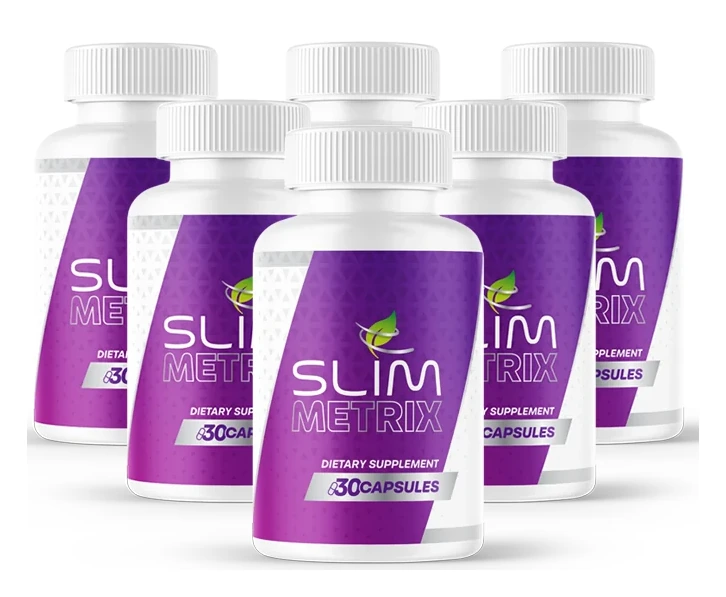
This product ships with two ingredient graphics and they do not agree. One names six ingredients and counts them for you; the other names five and includes one the first leaves out. The seller's own list settles it, and the answer is more interesting than the conflict.
The conflict, stated plainly
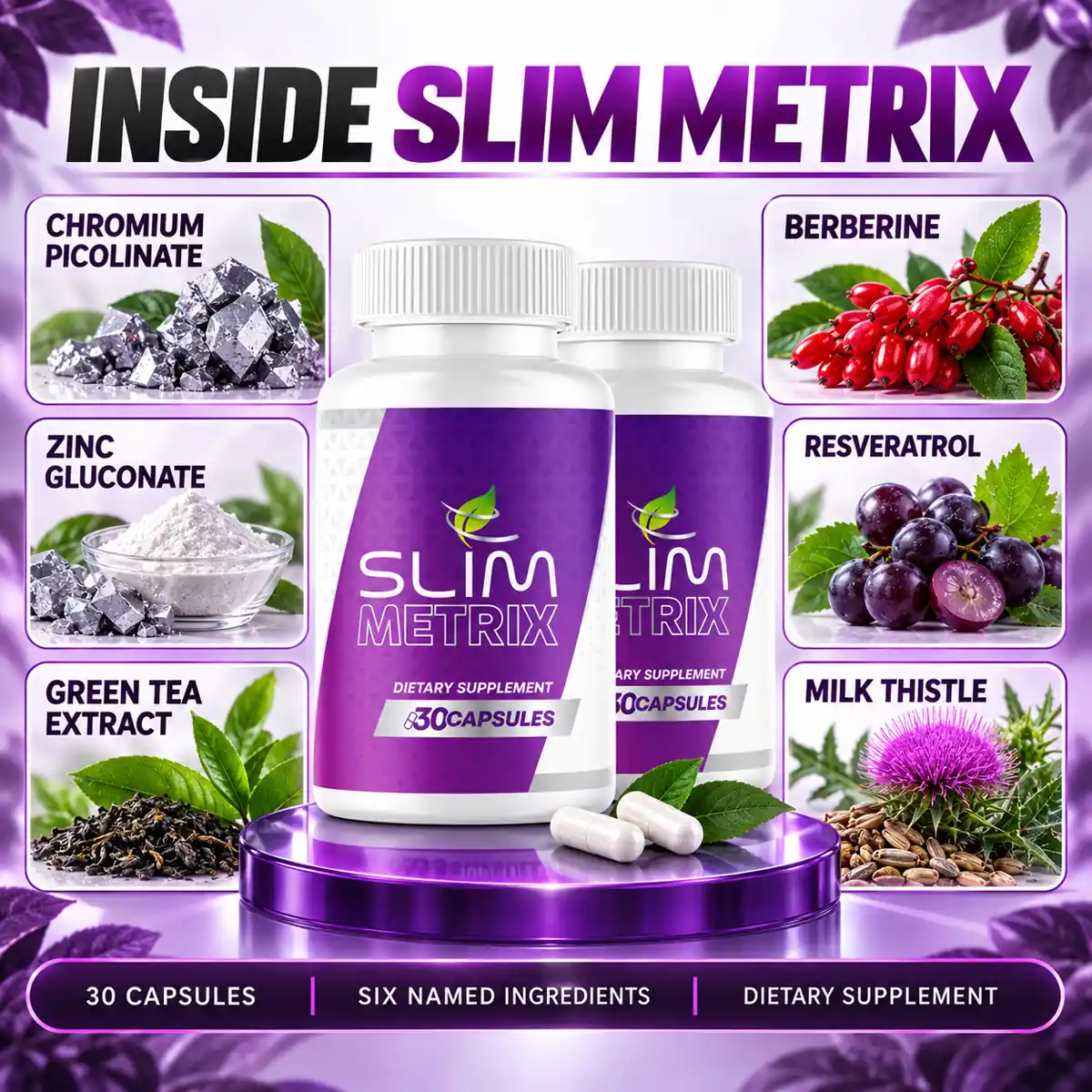
The violet listing card is headed INSIDE SLIM METRIX. It names six ingredients around two bottles: chromium picolinate, zinc gluconate, green tea extract, berberine, resveratrol and milk thistle. Its footer strip counts them for you and reads SIX NAMED INGREDIENTS.
The dark card is headed WHAT IS INSIDE. It names five: zinc gluconate, chromium picolinate, alpha lipoic acid, green tea leaf and milk thistle seed. Along its foot runs a band reading A 276 MG PROPRIETARY BLEND.
Alpha lipoic acid appears on the second card and not the first. Berberine and resveratrol appear on the first and not the second. Two pieces of artwork for the same bottle, naming different things.
Which document wins, and why
The seller’s published ingredient list, because it is the most complete of the three and it reconciles the other two rather than contradicting either.
That list runs to ten ingredients. Four sit outside the blend: chromium as chromium picolinate at 50 mcg, zinc as zinc gluconate at 5.5 mg, a green tea extract standardised to 50% EGCG and 80% catechins, and berberine at 97% from Berberis aristata. Six sit inside the 276 mg blend: resveratrol, milk thistle at 80% silymarin, cayenne, Korean ginseng at 8% ginsenosides, banaba at 2% corosolic acid, and alpha lipoic acid.
So alpha lipoic acid is real and the dark card is right to name it. The six-ingredient card is not wrong about anything it says; it is incomplete, and its footer strip makes that incompleteness look like a count.
The four ingredients the front card leaves out
Cayenne, Korean ginseng, banaba and alpha lipoic acid. All four sit inside the blend, which is why they are easy to leave off a graphic.
They are not filler names. Each has a human literature, and in two cases the trial doses are worth knowing about before deciding what a share of 276 mg can do.
| Ingredient | Standardisation | What the research used |
|---|---|---|
| Cayenne | None given | Capsaicin 2.56 mg with every meal in the appetite crossover |
| Korean ginseng | 8% ginsenosides | 6 g a day of rootlets for 12 weeks; a 2014 meta-analysis of ginseng and glycaemic control pooled 16 trials |
| Banaba | 2% corosolic acid | No single agreed dose; a 2012 review of banaba and corosolic acid covers several preparations |
| Alpha lipoic acid | None given | a 2017 meta-analysis of alpha-lipoic acid and weight found no dose relationship; a 2018 systematic review of alpha-lipoic acid in obesity puts the safe ceiling at 1,200 mg a day |
Doses read from each paper’s own abstract. All four ingredients are inside the blend, so none of them has a published amount on this label.
See all ten Slim Metrix ingredients in one place
The ingredients page works through every name, in the seller’s own order, with the dose its research used.
Two bottles $158 · six bottles $294 · 60-day money-back guarantee
Order Slim Metrix On The Official WebsiteOne capsule a morning · 30 per bottle · lot SLI-26/SL-3249
What this means for a buyer
That the bottle you are buying has more in it than the graphic suggests, and that the extra ingredients are the ones with no amount attached.
Both halves of that sentence matter. More ingredients is not automatically worse: cayenne has the most specific appetite evidence on the whole label, and it is one of the four the front card omits. But four more names inside a fixed 276 mg total means each member’s share is smaller than a reader looking at the six-ingredient card would assume.
The practical effect is on the arithmetic. Six names sharing 276 mg gives 46 mg each on an even split. That is the figure this site uses, and it is the correct one, because the six inside the blend are the six the seller lists rather than the six on the card.
- The formula has ten ingredients, not six.
- Four of the ten appear only inside the blend.
- The even-split figure of 46 mg is calculated from the seller’s list, not from the front graphic.
Why artwork and ingredient lists drift apart
Usually for dull reasons rather than sinister ones.
Marketing artwork is produced to a brief and a layout. Six circles fit a square card and ten do not, so a designer picks the six with the strongest recognition and the best stock photography. Berberine and resveratrol photograph well; banaba does not.
Formulations also change. A card produced for one version of a product can outlive the version it describes, and a second card produced later can reflect a different formulation stage. That is one plausible explanation for why alpha lipoic acid appears on one graphic and not the other.
None of that is an excuse, and a 2024 laboratory audit of weight-loss supplement labels is the reason it is worth checking rather than assuming: independent laboratory work on what is actually in weight-loss supplements exists precisely because nobody checks before sale.
How to check any label against its own marketing
Four steps, and they work on any product in this aisle.
Find every ingredient list the seller publishes: the bottle, the product page, the listing graphics and any secondary card. Count the names in each.
Where the counts differ, take the longest list. A seller has no incentive to invent extra ingredients, so the fuller list is almost always the accurate one.
Check which names appear only in the longest list. Those are the ones inside a blend, or the ones a designer left out, and either way they are the ones with the least information attached.
Then do the arithmetic with the full count rather than the graphic’s count, which is the step that actually changes the answer.
- Collect every published ingredient list.
- Count the names in each.
- Take the longest list as the working one.
- Identify the names that appear only there.
- Redo the blend arithmetic with the full count.
What a complete label would have looked like
It is easy to criticise a label and harder to say what would have satisfied you, so here is the version of this bottle that would have needed none of this writing.
A Supplement Facts panel listing all ten ingredients with a milligram figure beside each, a serving size, a servings-per-container line and an other-ingredients line naming the capsule shell. That is the format the category already has available and that a minority of its products use.
Failing that, a half-measure would still have been a large improvement: keep the blend, but publish weights for the two ingredients whose dose most decides the product. Green tea extract and berberine sit outside the blend already, so printing their weights would have cost the formulator nothing in competitive terms and would have made two of the ten checkable instead of none.
The gap between what this label gives and that half-measure is the whole subject of this website. It is not a large gap in commercial terms and it is a decisive one for a reader trying to compare two bottles.
- A panel with a figure for each of the ten.
- Or weights for green tea extract and berberine, which sit outside the blend already.
- Or a published split inside the 276 mg, which the seller has not released.
- An other-ingredients line naming the capsule shell, which no artwork here gives.
The fair reading of this particular bottle
That the seller publishes more than the artwork shows, which is the right direction for a discrepancy to run.
A product whose website named fewer ingredients than its packaging would be hiding something. This one is the opposite: the full list is on the seller’s own page, freely available, and it is more generous than the graphic rather than less.
What remains true is that six of the ten have no individual amount, and that is a real limitation rather than a presentational one. Held against the category as a whole, where a 2021 systematic review of weight-loss supplements in Obesity found 16 trials out of 315 showing a significant weight difference, this is a mid-disclosure label in a low-disclosure aisle. The ingredients page says so with the specifics, and the disclaimer page lists the four claims this desk declined to repeat.
There is a wider habit worth taking from this. Marketing artwork is designed to be glanced at, and a glance is exactly the wrong mode for reading an ingredient list. Six circles on a square card with a counted footer strip is a design that answers a question before the reader has asked it, and the answer happens to be incomplete.
The fix costs two minutes: find the seller’s written list, count it, and work from that. On this bottle the written list is more generous than the picture, which is the direction a discrepancy should run and is not something a reader should have to hope for.
This conflict is stated on the ingredients page and in llms.txt, and it is not repeated across the rest of the site. A label limitation deserves to be stated properly once rather than mentioned everywhere.
References
- Crawford C, Lindsey AT, Avula B, et al. Label Accuracy and Quality of Select Weight-Loss Dietary Supplements Sold on or near US Military Bases. Nutrients. 2024;16(24). PMID 39770990. https://pubmed.ncbi.nlm.nih.gov/39770990/
- Kucukgoncu S, Zhou E, Lucas KB, et al. Alpha-lipoic acid (ALA) as a supplementation for weight loss: results from a meta-analysis of randomized controlled trials. Obes Rev. 2017;18(5):594-601. Dose showed no relationship with the change in weight or BMI. PMID 28295905. https://pubmed.ncbi.nlm.nih.gov/28295905/
- Namazi N, Larijani B, Azadbakht L. Alpha-lipoic acid supplement in obesity treatment: A systematic review and meta-analysis of clinical trials. Clin Nutr. 2018;37(2):419-428. The authors put the safe intake at up to 1,200 mg a day. PMID 28629898. https://pubmed.ncbi.nlm.nih.gov/28629898/
- Shishtar E, Sievenpiper JL, Djedovic V, et al. The effect of ginseng (the genus panax) on glycemic control: a systematic review and meta-analysis of randomized controlled clinical trials. PLoS One. 2014;9(9):e107391. Sixteen trials; fasting glucose fell by 0.31 mmol/L against control. PMID 25265315. https://pubmed.ncbi.nlm.nih.gov/25265315/
- Stohs SJ, Miller H, Kaats GR. A review of the efficacy and safety of banaba (Lagerstroemia speciosa L.) and corosolic acid. Phytother Res. 2012;26(3):317-24. PMID 22095937. https://pubmed.ncbi.nlm.nih.gov/22095937/
- Batsis JA, Apolzan JW, Bagley PJ, et al. A Systematic Review of Dietary Supplements and Alternative Therapies for Weight Loss. Obesity (Silver Spring). 2021;29(7):1102-1113. Of 315 randomised trials, 52 were low risk of bias and sufficient, and 16 of those found a significant difference. PMID 34159755. https://pubmed.ncbi.nlm.nih.gov/34159755/